
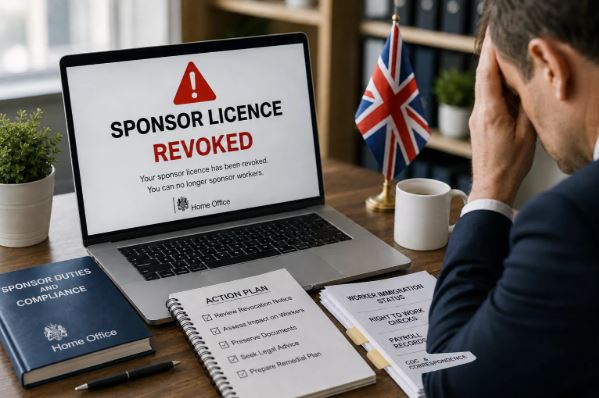
You finally got the job. The salary is coming in, your rent is covered, you’re sending money home, and you are beginning to feel settled in the UK.
Then one day, you hear that your employer has lost, or may lose, their sponsor licence.
That can be terrifying when your right to work and remain in the UK is connected to that employer. But take a breath. Your employer losing its sponsor licence does not automatically mean you have to leave the UK immediately. What matters is what happens to your immigration permission and how quickly you respond.
The UK government confirms that when a sponsor loses its licence, an existing worker’s Certificate of Sponsorship is cancelled and their permission will normally be limited to 60 days, or the time remaining on their visa if that is less than 60 days. You can use that period to make a new immigration application if you qualify.
So, if this ever happens to you, don’t spend the first few weeks panicking. Use them strategically.
What Happens When Your UK Sponsor Loses Its Licence?
The first thing to understand is that suspension and revocation are not the same thing.
If your employer’s sponsor licence is suspended, the Home Office is essentially investigating the sponsor’s compliance. If you are already working for the company, you can generally continue working while the suspension is being dealt with. Your situation is therefore different from someone whose employer’s licence has already been revoked.
Revocation is more serious.
Once the sponsor licence is lost, the Home Office can cancel or shorten your immigration permission. For a worker who was not involved in the reasons behind the revocation, the normal approach is to leave them with up to 60 days to find another route or make arrangements to leave the UK.
That distinction matters because you don’t want to resign from your job simply because you have heard rumours that your employer is “having problems with UKVI.”
Get the facts first.
If your employer tells you its licence has been suspended, ask what that actually means for your role. If you receive correspondence from UKVI about cancellation or curtailment of your permission, treat that letter as urgent.
Your immigration status is too important to manage based on WhatsApp rumours or what another colleague thinks is happening.
Don’t Waste Your 60-Day Window
If your permission is shortened to 60 days, think of that period as your immigration transition window, not as two months of free time.
The government specifically states that you will have to leave your job and leave the UK unless you make a new visa application within the relevant period.
This is where preparation becomes your best friend.
Start looking for another licensed sponsor immediately. Don’t wait until week six because you are hoping your employer will somehow fix everything.
You can search the official Register of licensed sponsors to identify organisations currently licensed to sponsor workers. The register includes the organisation, the immigration routes it can sponsor and its sponsorship rating.
Check the official Register of licensed sponsors
And please don’t just search for the words “visa sponsorship available” on a job board and assume the employer can sponsor you.
A company may be hiring, but that does not necessarily mean it is licensed to sponsor your particular role. You need to check the employer and the relevant immigration route carefully.
Your Next Job Needs to Work for Your Visa Too
This is where panic can make people vulnerable.
Imagine you have 60 days to find another employer. A company offers you a job tomorrow and promises, “Don’t worry, we’ll sort out the sponsorship.”
It sounds like a miracle.
But this is exactly when you need to slow down.
Your new role must meet the requirements of the immigration route you’re applying under. The employer must be able to sponsor you, and the job itself must satisfy the relevant eligibility and salary requirements. The Skilled Worker route, for example, requires sponsorship for an eligible occupation and a valid Certificate of Sponsorship.
So don’t evaluate the offer purely by asking, “Does this company sponsor?”
Ask the bigger questions: Is the employer currently licensed? Can they sponsor this particular role? Does the salary meet the current requirements? Is the occupation eligible? Will the proposed job genuinely support your immigration application?
And most importantly, do not assume that receiving a job offer automatically transfers your existing visa to the new employer.
You normally need to make the appropriate immigration application and receive the necessary permission before starting the new sponsored role.
Audit the New Employer Before You Sign
Losing one sponsor should teach you something important: your employer’s immigration compliance matters to your future.
Before accepting another sponsored position, investigate the organisation as carefully as you would investigate a house before signing a tenancy agreement.
Check the official sponsor register. Look at the type of sponsorship licence they hold and their rating. Ask the employer directly about the sponsorship process, the proposed occupation code, salary and Certificate of Sponsorship.
You should also pay attention to how transparent their HR team is.
If a recruiter becomes strangely vague when you ask about sponsorship, promises that “the paperwork will come later,” or asks you to pay inappropriate sponsorship-related costs, treat that as a warning sign. UK sponsor guidance places significant compliance responsibilities on employers, and serious breaches can put their licence at risk.
The goal isn’t simply to escape your current employer.
The goal is to move from one secure immigration position to another.
Don’t Forget Your Career While Saving Your Visa
There is another trap here: taking the first available job without considering what it does to your career.
Of course, when your immigration status is under pressure, keeping lawful status is extremely important. But if you have spent years building experience in your profession, don’t automatically abandon that trajectory because you’re frightened.
Use your CV strategically. Contact recruiters. Speak to employers in your industry. Apply broadly, but apply intelligently.
And keep your professional network warm.
The best time to build relationships with potential sponsors isn’t necessarily when your 60-day clock has already started. If you’re currently on a Skilled Worker visa, keep an eye on the sponsorship market and maintain an updated CV even while your existing employment is stable.
That way, if something unexpected happens, you aren’t starting from zero.
Keep Your Immigration Paperwork in One Place
If your sponsor loses its licence, you don’t want to spend precious days searching through old emails for your passport, Certificate of Sponsorship details, payslips or previous visa documents.
Create a secure digital immigration folder now.
Keep copies of your passport, eVisa information, current immigration permission, employment contract, payslips, CoS details, qualification documents and important UKVI correspondence. Having your documents organised won’t guarantee a successful application, but it can make an urgent transition much easier.
And if you receive a formal curtailment or cancellation notice, get regulated immigration advice promptly, particularly if your circumstances are complicated or you have dependants whose status is connected to yours.
A Lost Sponsor Doesn’t Have to Mean a Lost Future
Your employer’s sponsor licence is important, but it is not the same thing as your entire future in the UK.
If a sponsor loses its licence and you are not responsible for the circumstances that caused the revocation, the rules can provide a period in which you can find another qualifying route. The government guidance specifically recognises that workers affected through no fault of their own may normally be given 60 days to make another application or prepare to leave.
So don’t freeze.
Check your official correspondence. Understand your deadline. Search for licensed sponsors. Prepare your documents. Get professional advice where necessary.
Most importantly, don’t wait until the final week.
Your UK life is bigger than one employer. The sooner you start building a backup plan, the less power one company’s compliance problems have over your future.



Leave a Reply